Category: Blog

Your blog category

  • x402: Unlocking Payments for the Agentic Web

    x402

    For over 30 years, the internet has been great at moving information but not money. We can send messages across the world in seconds, but paying for a song, a file, or an API call still feels stuck in another era.

    We’ve layered on endless fixes, ads, paywalls, subscriptions, and checkout pages, but none of them truly belong to the web’s original design. The web speaks HTTP, and while HTTP has codes for everything (200 for OK, 404 for Not Found), one status code has always been… empty. 402: Payment Required. It’s been waiting since 1992 for someone to give it meaning. The x402 protocol, introduced by Coinbase and the x402 Foundation, revives the long-dormant HTTP status code 402 (Payment Required) and gives it real purpose. Built as an open, blockchain-agnostic standard, x402 enables instant, programmable payments directly over HTTP, creating a bridge between the traditional web and the emerging machine-driven, value-centric internet.

    What is x402?

    Basically, x402 is an open protocol that integrates payments into standard web interactions. It allows websites, APIs, and services to request and receive payments seamlessly, without requiring logins, subscriptions, or centralized processors.

    At its core, x402 transforms the way a client (human or device) pays for access to a resource online. When a payment is required, the server responds with an HTTP 402 status and payment details. The client then processes the transaction, typically using stablecoins such as USDC, and resubmits the request with proof of payment.

    Because it operates within the familiar HTTP framework, x402 can be implemented with minimal changes to existing infrastructure, making it an elegant upgrade path for developers.

    How does x402 work at the protocol level?

    Here’s a simplified outline of how the protocol functions in practice:

    1. A client (user or device) requests access to a resource, such as an API call or digital asset.
    2. The server replies with HTTP 402 Payment Required, including payment parameters (amount, token, blockchain, recipient address).
    3. The client’s wallet or agent executes the payment and generates a verifiable payment payload.
    4. The client retries the request, including a X-Payment header with the signed transaction details.
    5. Once the server verifies the payment, either directly or via a facilitator, it returns HTTP 200 OK, delivering the resource.

    This sequence keeps the entire transaction flow within HTTP, merging content access and payment into a single, unified protocol.

    Why Does x402 Matter for Agentic Commerce?

    x402 is a transformative protocol that integrates payments directly into the web, enabling seamless, automated transactions for both humans and autonomous systems. Traditional payment methods often involve friction, intermediaries, or manual intervention, limiting efficiency for micropayments, API access, or machine-driven commerce.

    x402 addresses these limitations by leveraging the HTTP protocol itself: when a resource requires payment, the server issues a “402 Payment Required” response containing precise payment instructions. The client can then complete the transaction, verify settlement, and access the resource automatically. Compatible with stablecoins such as USDC, x402 provides a secure, scalable, and standardized framework for value exchange.

    By making financial transactions as straightforward as data requests, x402 establishes a foundation for the next-generation web, supporting both human users and agentic commerce in a more efficient and reliable manner.

    Difference between x402 and traditional payment APIs.

    As digital commerce evolves, especially with AI agents and autonomous systems becoming more common, the way payments are handled is shifting. x402 is a protocol-level solution built into the web itself, while traditional payment APIs like Stripe or PayPal rely on external platforms. The table below highlights the key differences:

    Featurex402Traditional Payment APIs (e.g., Stripe, PayPal)
    IntegrationEmbedded directly into the HTTP protocol, payment flows occur within standard web requests/responsesOperates through external APIs, SDKs, or forms outside the core web protocol
    Target UsersBoth humans and autonomous agents (AI, bots, IoT devices)Primarily humans; automation requires custom backend logic
    Settlement MethodSupports blockchain-based or stablecoin payments, enabling fast, global, and programmable transactionsUses fiat banking rails (cards, ACH), which can have delays, fees, and geographic limitations
    Automation & MicropaymentsOptimized for pay-per-use, micropayments, and agent-driven transactionsCan handle small payments but usually requires additional steps and is not agent-friendly
    FrictionMinimal; agents can pay, verify, and access resources automaticallyModerate; typically requires logins, confirmations, or human interaction
    Primary Use CasesAgentic commerce, AI services, APIs, IoT, microtransactionsE-commerce, subscriptions, SaaS billing, human-driven payments

    Conclusion

    The 402 status code was once a placeholder, a symbol of an unfulfilled idea. Today, x402 transforms that placeholder into a powerful standard that could reshape digital commerce.

    By embedding payments directly into the language of the web, x402 makes transactions faster, smarter, and more adaptive to the realities of an AI-driven economy. It’s more than a protocol; it’s a step toward a web where value moves as freely as information.

  • Zero-Knowledge Proofs (ZKPs): How They’re Redefining Privacy and Trust in the Digital Age

    Zero-Knowledge Proofs (ZKPs): How They’re Redefining Privacy and Trust in the Digital Age

    The internet runs on proof, but that proof usually comes at the cost of privacy. Every time you log in, shop online, or verify your age, you’re asked to prove yourself.
    Your name. Your email. Your ID. Your entire digital life, scattered across servers you’ll never see. It’s the cost of trust in today’s internet; you have to give something away to be believed. But what if you didn’t have to?
    What if you could prove something is true without giving up your secrets?

    That’s where Zero-Knowledge Proofs (ZKPs) help you.

    What are zero-knowledge proofs?

    Zero-Knowledge Proofs (ZKPs) are an advanced cryptographic technique that enables one party to prove the validity of a statement without revealing the underlying information. In essence, they allow trust to be established without compromising privacy. ZKPs operate on three fundamental principles: completeness, meaning a true statement can be successfully proven; soundness, ensuring false statements cannot be convincingly faked; and zero-knowledge, which guarantees that no additional information is disclosed beyond the proof itself. This technology has become a cornerstone of modern blockchain innovation, enhancing privacy and scalability across systems such as Zcash, which enables confidential transactions, and zkSync, which leverages ZKPs to efficiently validate large batches of transactions.

    Need for ZKPs.

    In today’s digital age, sharing personal information has become almost unavoidable. Every time we log in, make a payment, or verify our identity online, we inevitably reveal fragments of ourselves, from personal data and daily habits to sensitive private details. This constant exposure creates a tension between trust and privacy: we want systems to believe us, but the cost is often giving away more than we’re comfortable with. Zero-Knowledge Proofs (ZKPs) offer a groundbreaking solution to this problem. They allow us to prove that a statement or claim is true without ever revealing the underlying information. In other words, ZKPs enable trust without full disclosure.

    The core idea is elegantly simple: you don’t need to know everything to trust me. This is more than a technical innovation; it represents a fundamental shift in how we approach verification and privacy. By separating proof from exposure, ZKPs create a digital environment where authenticity and privacy can coexist, allowing individuals and organizations to interact securely without sacrificing sensitive information. In essence, zero-knowledge proofs are redefining trust for the digital era, making it possible to verify truth while keeping personal data truly private.

    How do ZKPs work?

    Zero-Knowledge Proofs (ZKPs) operate based on three fundamental principles that ensure both reliability and privacy. Completeness guarantees that if a statement is true, an honest prover can always convince the verifier of its validity. Soundness ensures that if the statement is false, no prover, no matter how clever, can trick the verifier into accepting it as true. Finally, the zero-knowledge property preserves privacy by making certain that the verifier gains no additional information beyond the fact that the statement is true. Together, these principles allow ZKPs to provide a secure and trustworthy method of verification, where the prover can demonstrate knowledge or validity without ever revealing the underlying information, making it an exceptionally powerful tool for privacy-preserving applications.

    The future of privacy.

    We’re only beginning to understand the potential of zero-knowledge proofs, and while the technology is still complex and challenging to implement, its promise is clear. Instead of building the future of the internet on constant surveillance and data collection, ZKPs offer a way to create trust through mathematics and proofs, without ever invading personal privacy. In a world overwhelmed by data and constant digital exposure, they quietly suggest something revolutionary: you don’t need to reveal everything about yourself to be trusted or believed. This subtle shift could reshape how we interact online, making privacy and security a natural part of the digital experience rather than an afterthought.

    Conclusion

    Zero-knowledge proofs are more than just a technical innovation; they represent a paradigm shift in how we think about trust, privacy, and digital interactions. By allowing verification without exposure, ZKPs empower individuals and organizations to interact securely, confidently, and privately. As the digital world continues to expand, this technology offers a path toward an internet where authenticity and privacy coexist, proving that it’s possible to be both trusted and protected in the online age.

  • The Rise of Real-World Assets: Bridging the Gap Between Traditional Finance and Web3

    Real-World Assets

    For most people, crypto still feels distant. It is full of innovation but detached from the real economy. You can buy a meme coin, swap a token, or mint NFTs, but none of that really touches your day-to-day life. That’s changing fast.

    A new wave of projects is connecting blockchain to the tangible world through Real-World Assets (RWAs), and it might just redefine what “value” means in the digital age. From real estate and gold to art and bonds, tokenization is turning traditionally illiquid assets into digital, tradable tokens on the blockchain.

    What Are Real-World Assets (RWAs)?

    Real-World Assets (RWAs) are simply the things we already value in the real world, i.e., homes, gold, artwork, bonds, or even commodities, brought into the digital world through tokenization. Think of tokenization as a way of turning ownership of something physical into digital tokens that anyone can buy, sell, or trade. For instance, imagine a building worth $1 million being split into 10,000 tokens priced at $100 each. Suddenly, instead of needing a fortune to invest in real estate, anyone can own a small piece of it and even earn a share of the returns.

    RWAs bridge traditional finance (TradFi) and decentralized finance (DeFi), creating a world where real assets meet blockchain technology. They make investing more inclusive, increase liquidity for assets that are usually hard to trade, and offer more transparency since everything is recorded on-chain.

    How RWA Tokenization Works

    1. Asset Selection: Someone identifies a real asset worth tokenizing.
    2. Legal Structuring: Legal checks and frameworks ensure everything’s compliant.
    3. Token Creation: Tokens are created, each representing a small part of that asset.
    4. Off-Chain Verification: Use oracles and audits to link real-world data to blockchain tokens.
    5. Distribution & Trading Investors can buy or sell these tokens through blockchain platforms or wallets.

    So instead of one big piece of gold or one fancy painting sitting in a vault, you have thousands of digital shares, all backed by the real thing.

    But It’s Not All Perfect Yet

    Every revolution comes with fine print. RWAs are no different.

    • Regulation still lags behind innovation.
    • Custody of physical assets is a trust issue; someone, somewhere, still holds it.
    • Liquidity sounds great, but secondary markets are still growing.
    • Transparency depends on accurate real-world data, and that’s not always easy to verify.

    But these challenges aren’t deal-breakers.
    They’re just growing pains, the kind that every big innovation goes through before it goes mainstream.

    Where Tychi Wallet Fits In

    Projects like Tychi Wallet are quietly building the rails for this new era.

    Tychi’s focus on cross-chain interoperability, DeFi access, and DApp integration makes it a natural gateway for the RWA revolution. Imagine logging into your Tychi Wallet and seeing:

    • ETH and BTC next to your tokenized real-estate shares
    • Gold-backed tokens generating yield
    • NFT certificates tied to real-world art

    That’s not science fiction; it’s the next logical step in Web3 evolution.

    Conclusion

    Real-world assets are the bridge Web3 has been waiting for.
    They reconnect digital innovation with tangible value, grounding blockchain in the real economy.

    As wallets like Tychi evolve, they won’t just store your crypto.
    They’ll store your ownership in the real world, all at the speed of the internet.

    The future of finance isn’t crypto versus traditional.
    It’s both, woven together, token by token.

  • Universal Gas Framework (UGF): One token, all chains, seamless transactions.

    Why Web3 feels Complicated

    Web3 isn’t as easy as it should be. If you’ve ever used more than one blockchain, you know the struggle. You’re trying to send a transaction on Polygon, but you don’t have any MATIC. You bridge your tokens over, but now you’re stuck again because the network wants a different gas token. Before you know it, half your time in Web3 goes into figuring out how to make something work instead of why you’re doing it. It’s confusing, slow, and unnecessarily complicated.

    It’s one of the biggest obstacles standing between blockchain technology and true mass adoption. People love innovation, but they don’t love friction. That’s where Tychi’s UGF steps in, a system built to end the chaos. UGF makes it possible to pay gas fees across multiple blockchains using just one token, no matter which network you’re on. Simple, smart, and surprisingly overdue.

    What is UGF

    The Universal Gas Framework is exactly what it sounds like; it’s basically a translator for blockchain gas payments. Universal Gas Framework is a system that allows you to pay gas fees across different blockchains using just one token. No matter where your transaction is happening, be it Ethereum, Solana, or any other supported chain. UGF takes care of the heavy lifting behind the scenes.

    UGF handles it automatically. Instead of users juggling multiple native tokens, UGF converts and settles gas fees automatically. You send your transaction in one token, and UGF ensures that the right network gets paid. It’s simple, secure, and invisible. This solution is part of the Tychi ecosystem, which offers a developer SDK so wallets and dApps can easily integrate it. That means the UGF experience isn’t limited to Tychi’s wallet; it can be embedded across the Web3 landscape, creating a more connected ecosystem for everyone.

    Why does it matter?

    For users, UGF makes blockchain usable again. It removes the friction of swapping tokens just to cover fees, prevents failed transactions, and simplifies how people interact with decentralized apps. Transactions become smoother, faster, and less stressful. That’s the kind of experience that can finally make Web3 feel as easy as Web2.

    For developers, UGF removes one of the biggest headaches in blockchain design: gas management. By integrating the framework, they can offer frictionless onboarding, no need to explain gas fees, and no need for multiple steps before a user can even interact with the app.

    In short, UGF makes Web3 accessible again, not just for crypto veterans, but for anyone curious about decentralized technology.

    How It Works Behind the Scenes

    Don’t let the simplicity fool you; there’s a lot going on under the hood. UGF uses a secure, risk-managed infrastructure that ensures every gas payment is processed safely and efficiently.

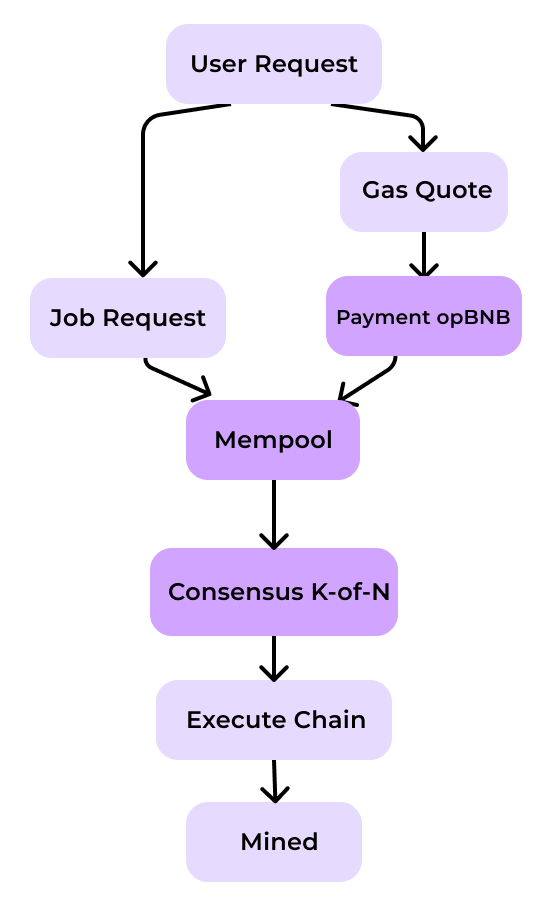
    It automates the entire flow, from calculating and sponsoring fees to executing the transaction on the target chain, all while keeping everything transparent and verifiable. It’s the kind of quiet, intelligent system that makes complexity disappear, so users can focus on what actually matters: their interaction, not the infrastructure.

    A Glimpse Into the Future

    The Universal Gas Framework is more than a convenience feature; it’s a milestone in blockchain evolution. By removing one of the biggest friction points in the Web3 experience, Tychi is helping the ecosystem take a major step toward true mainstream adoption.

    Imagine a future where your wallet works everywhere, one balance covers every chain, and “running out of gas” is a thing of the past. That’s the future UGF is building, one where Web3 finally feels seamless, human, and intuitive.

    With Tychi leading the charge, that future doesn’t just sound exciting; it’s already on its way.

  • Tychi Wallet x TaskOn: Promotional Campaign

    Updated on: Aug 27, 2025

    Tychi Wallet x TaskOn $300 USDT Giveaway banner featuring 30 winners, with Tychi mascot holding a Tether coin and glowing NFT box illustration.

    In Brief:
    After the success of our first giveaway, Tychi Wallet is back with its promotional Campaign, this time in partnership with TaskOn, featuring a $300 USDT prize pool!

    Task Details

    Tychi Wallet was built to fix the everyday struggles of Web3 users: no more juggling multiple gas tokens, no more chain-hopping confusion, and no more friction in managing your assets.

    With our Universal Gas Framework (UGF), you can pay gas fees with a single token (BNB or TYI) across all supported chains, something no other wallet offers.

    To celebrate our growing community, we’re rewarding supporters with a chance to win a share of $300 USDT in our Campaign on TaskOn.

    👉 Campaign Type: Tychi Airdrop
    👉 Winners: Multiple participants will be rewarded
    👉 Prize Pool: $300 USDT
    👉 Official Campaign Page: https://taskon.xyz/TychiWallet

    Promotion Period

    🗓 Start Date: August 27, 2025
    🗓 End Date: September 15, 2025

    How to Participate

    1️⃣ Download Tychi Wallet

    • Install from here: https://play.google.com/store/apps/details?id=com.tychiwallet2
    • Set up your wallet and get ready.

    2️⃣ Join the Campaign on TaskOn

    • Go to the official Tychi x TaskOn campaign page.
    • Connect your wallet and social accounts.
    • Complete all the listed tasks (follow, join channels, engage).

    3️⃣ Secure Your Spot

    • Only wallets created with Tychi Wallet will qualify.
    • Finish all mandatory tasks to be eligible.

    Rewards

    💰 Total Prize Pool: $300 USDT
    🎉 Multiple Winners will share the pool
    🏆 Rewards are distributed to eligible Tychi Wallet addresses after campaign verification.

    Why Join?

    By participating, you not only earn rewards but also get hands-on with Tychi’s Universal Gas Framework (UGF), the first wallet to let you pay gas fees with a single token across chains.

    ✔️ No more swapping for native gas tokens
    ✔️ Smooth cross-chain experience
    ✔️ Web3 made simple

    Terms & Conditions

    Only Tychi Wallet users are eligible.

    Each wallet can win once

    Fake/bulk accounts will be disqualified.

    For full details, please visit TaskOn’s official Terms & Conditions page.

    Tychi Wallet reserves the right to update or cancel the campaign.

    About TaskOn

    TaskOn is a Web3 growth platform that helps projects build active communities through quests, campaigns, and reward-driven participation.

    About Tychi Wallet

    Tychi Wallet is a next-generation Web3 wallet solving real user problems, from gas fee struggles to multi-chain complexity. With support for 20+ blockchains and our Universal Gas Framework (UGF), Tychi delivers a smoother, smarter, and simpler Web3 experience.

    Download Tychi Wallet now and start your journey today.

  • Tychi Wallet Featured by BNB Chain: Making Web3 Simple for Everyone.

    Big news,
    We’re super excited to share that BNB Chain has featured Tychi Wallet as one of the newest projects live in their ecosystem. For us, this isn’t just a shoutout; it’s a huge milestone in our journey to make Web3 easier, faster, and way more fun for everyone.

    BNB Chain features Tychi Wallet for simplifying multi-chain gas fees with Universal Gas Framework

    Why This Means So Much.

    BNB Chain is one of the most powerful and vibrant ecosystems in Web3. Known for its speed, low fees, and massive community of dApps, it’s where a lot of innovation is happening right now.

    So, being recognised by BNB Chain is more than just an achievement; it’s a clear sign that Tychi Wallet is solving real problems for real users.

    What Makes Tychi Wallet Stand Out

    If you’ve ever tried using different blockchains, you know the pain—every chain needs its own gas token. ETH for Ethereum, SOL for Solana, AVAX for Avalanche… It gets complicated fast.

    That’s where our Universal Gas Framework (UGF) steps in. Powered by BNB Chain, it lets you:

    ➡️ Pay gas fees on any supported chain using a single balance of BNB or TYI.

    ➡️ Forget juggling multiple wallets and tokens just for simple transactions.

    ➡️ Enjoy a smooth, one-wallet experience that makes multi-chain feel like a single chain.

    Building the Future of Web3, Together

    This recognition from BNB Chain gives us even more energy to keep building. We’re not just creating another wallet; we’re building a gateway to a frictionless Web3, where switching between chains feels natural, not stressful.

    With BNB Chain’s powerful infrastructure and Tychi Wallet’s innovative design, we’re paving the way for a future where Web3 is:
    ✅ Simple
    ✅ Fast
    ✅ User-first

    This is only the beginning. Big things are ahead, and we’re building them together with you.

    One Wallet. Every Chain. Zero Friction.
    That’s the Tychi way.

  • How to Do Crypto Swaps in Tychi Wallet: Step-by-Step Guide

    Learn how to do crypto swaps in Tychi Wallet with ease. Same-chain and cross-chain swaps are now seamless with one-tap Universal Gas Fee support.

    Introduction: The New Era of Crypto Swaps

    Swapping tokens across different blockchains has long been complicated. High fees, failed transactions, and the hassle of holding multiple gas tokens create friction for users. Tychi Wallet solves this with a new approach.

    Powered by its Universal Gas Framework (UGF) and one-tap swap system, Tychi lets you perform both same-chain and cross-chain swaps instantly without worrying about gas tokens or failed routes.

    What is Tychi Wallet?

    Tychi Wallet is a secure, non-custodial Web3 wallet designed to simplify digital asset management. With support for 20+ blockchains, it enables you to:

    • Store and protect private keys.
    • Buy, sell, and stake crypto.
    • Access decentralised apps (dApps).
    • Perform one-tap same-chain and cross-chain swaps.

    Unlike other wallets, Tychi doesn’t require native gas tokens. With UGF, you can pay swap fees using BNB and TYI, making transactions seamless across ecosystems.

    What Are Crypto Swaps?

    A crypto swap lets you exchange one token for another directly in your wallet fast, non-custodial, and without centralised exchanges.

    Tychi enhances this by integrating with DEX aggregators and partners like Rango Exchange, sourcing the best liquidity from platforms such as Uniswap and PancakeSwap. Before confirming, Tychi displays the routed path, estimated fees, and slippage, giving you complete transparency.

    How to Do Crypto Swaps in Tychi Wallet

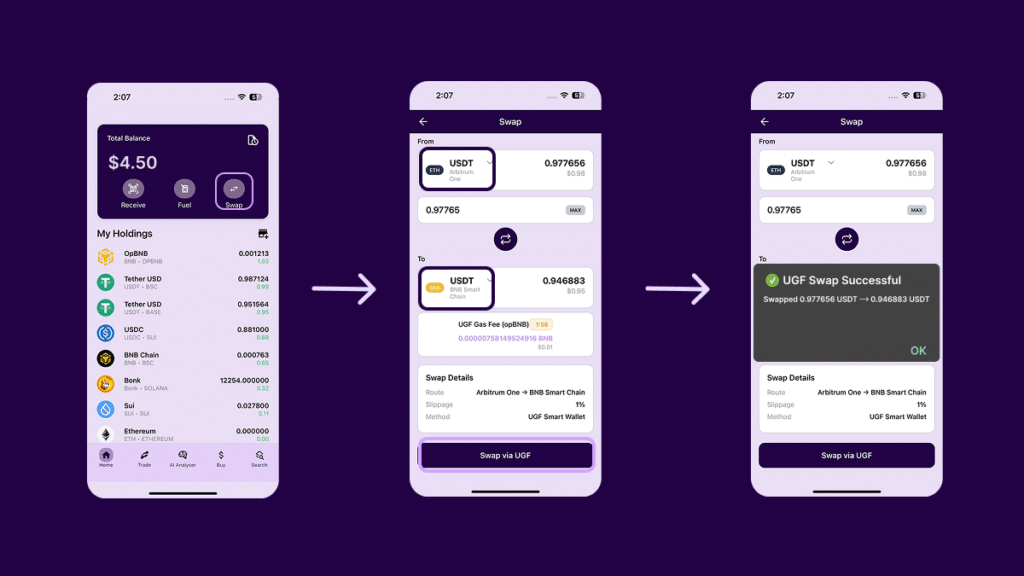
    1. Open the Tychi Wallet app.
    2. Tap the Swap button.
    3. Choose the token you want to swap and the one you want to receive.
    4. Enter the amount.
    5. Review the quote (path, slippage, fees).
    6. Tap Confirm—your swap completes in one tap, with gas handled by UGF.

    This simple flow works for both same-chain and cross-chain swaps.

    Same-Chain Swaps

    Same-chain swaps exchange tokens within the same blockchain (e.g., ETH → USDT on Ethereum). With Tychi:

    • Swaps are fast and optimised.
    • No failures from insufficient gas.
    • Execution is one tap away.

    Perfect for quick DeFi trades or portfolio adjustments.

    Cross-Chain Swaps

    Cross-chain swaps (e.g., ETH → BNB) usually require external bridges and multiple wallets. Tychi removes that complexity by:

    • Using secure cross-chain bridges.
    • Routing through the best liquidity sources automatically.
    • Handling fees with UGF (no need for ETH, BNB, or other native gas).
    • Ensuring reliability with a dynamic fallback system if one route fails.

    This opens the door to exploring new chains without technical barriers.

    Tychi Wallet app showing step-by-step cross-chain swap with Universal Gas Fee (UGF) — swapping USDT from Arbitrum One to BNB Smart Chain in a single transaction, confirming UGF swap success

    Why Tychi Wallet Stands Out

    Most wallets demand gas tokens for each blockchain. Tychi removes that friction with UGF and intelligent routing.

    Key advantages of swaps in Tychi Wallet:

    • One balance for all gas fees (BNB, TYI, or supported tokens).
    • Same-chain & cross-chain swaps in one tap.
    • Trusted routing partners like Rango Exchange.
    • 20+ blockchain support (EVM and non-EVM).
    • Transparent fee/slippage display before confirmation.
    • Non-custodial security — private keys remain on your device.

    Conclusion: Swaps That Just Work

    Tychi Wallet is redefining how users swap tokens. Whether you need a fast same-chain swap or a complex cross-chain transfer, Tychi makes it effortless.

    With universal gas fees, partner-powered liquidity, secure bridges, and support for 20+ chains, Tychi isn’t just another wallet; it’s a complete Web3 ecosystem built for trust, speed, and simplicity.

    Stop worrying about gas tokens or failed transactions. With Tychi Wallet, crypto swaps just work.

  • Universal Gas Framework: The End of Multi-Chain Gas Complexity

    Tychi Wallet integrates Universal Gas Framework (UGF) with BNB Chain Stack including opBNB, Greenfield, and BNB Bridge.”

    You discover an amazing DeFi opportunity on a new chain, but you’re stuck because you don’t have the native token for gas fees. You need to bridge assets, swap tokens, and navigate multiple interfaces just to complete a simple transaction. Sound familiar?

    This exact scenario has played out millions of times across the blockchain ecosystem. After years of witnessing this recurring pain point, a solution emerged in early 2024 that would fundamentally change how we think about cross-chain gas payments.

    The Reality Check: Gas Tokens Are Everywhere.

    Every blockchain interaction today comes with an invisible tax of complexity. Want to trade tokens on Ethereum? You need ETH for gas. Planning to use Avalanche? AVAX becomes essential. Considering tokens on BNB Chain? BNB is your entry ticket. The pattern repeats endlessly, creating a fragmented experience that contradicts the very promise of connected Web3.

    Even seasoned DeFi users find themselves trapped with assets they can’t move, opportunities they can’t seize, and transactions they can’t complete, all because of gas token fragmentation. Current solutions like paymasters are chain-specific fixes that require individual blockchain support, leaving users to navigate the same complex processes across different networks.

    Enter the Game Changer: Universal Gas Framework.

    Universal Gas Framework (UGF) represents a paradigm shift. Rather than forcing users to juggle multiple gas tokens, UGF operates as an intelligent solution that handles all the complexity behind the scenes. Users maintain a single BNB balance and can interact with any supported blockchain seamlessly. Ethereum, Polygon, Solana, Sui, and beyond.

    As one industry expert noted, “The concept of UGF is interesting and could be another option besides paymasters. Paymasters need each chain to support, which is more complex. UGF can be a sidecar for multiple chains with a more elegant design.”

    Think of UGF as a universal travel card for blockchain gas. Want to claim that Solana airdrop? UGF converts and pays the SOL. Need to execute an Ethereum DeFi strategy? UGF handles the ETH gas seamlessly. The user experience transforms from managing multiple balances to simply having one.

    Why BNB Makes Perfect Sense

    The choice of BNB as the universal gas token reflects careful consideration of accessibility and adoption. BNB ranks among the most widely held cryptocurrencies globally, making it accessible to users across different market segments. The underlying infrastructure provides the technical foundation for handling massive transaction volumes with minimal fees and fast execution.

    Omnichain Infrastructure: Powered by opBNB

    At the heart of the Universal Gas Framework lies its omnichain architecture, built on opBNB’s high-performance infrastructure. This omnichain approach means UGF doesn’t just connect different blockchains—it creates a unified experience where chain boundaries become invisible to users.

    opBNB’s optimised architecture serves as the perfect foundation for omnichain operations, offering near-instant transaction finality and ultra-low fees that make cross-chain gas payments economically viable even for microtransactions. The omnichain design ensures that whether you’re interacting with Ethereum, Solana, Polygon, or any other supported network, the experience feels native and seamless.

    This omnichain capability transforms the multi-chain landscape from a fragmented ecosystem into a cohesive Web3 environment where users can move freely between protocols and opportunities without technical barriers.

    Beyond Traditional Solutions: A Truly User-Friendly Approach

    While traditional paymasters require each blockchain to implement specific protocols, UGF operates as an independent multi-chain solution that works across diverse blockchain architectures without requiring individual chain modifications.

    As one industry expert noted, “The concept of UGF is interesting and could be another option besides paymasters. Paymasters need each chain to support, which is more complex. UGF can be a sidecar for multiple chains with a more elegant design.” -BNB Chain Tech team

    Crucially, UGF maintains a completely self-custodial design. Users retain full control over their assets and private keys at all times. UGF never takes custody of funds, it simply facilitates gas payments on behalf of users while they maintain complete ownership. The system includes robust security measures for maximum protection.

    Seeing It in Action: Real-World Implementation

    The integration of UGF with modern wallet solutions demonstrates seamless real-world implementation. Users deposit into their BNB gas balance once, then interact with any supported blockchain without ever thinking about gas token management again.

    To make the experience even more seamless, wallets implementing the UGF feature an inbuilt bridge specifically for BNB to opBNB transfers. This integrated bridging solution allows users to easily convert their BNB holdings to opBNB directly within their wallet interface, ensuring they can quickly add fuel to their universal gas balance whenever needed. No external bridge protocols, no complex multi-step processes—just a simple, one-click solution to top up your omnichain gas tank.

    This unified approach eliminates the friction between gas management and wallet experience, setting the standard for seamless Web3 interaction.

    Building the Future: What’s Next

    The UGF roadmap includes support for additional major chains like Aptos, XRP, and Bitcoin. A comprehensive developer toolkit will enable any wallet or dApp to integrate universal gas capabilities. Complete transparency tools will provide visibility for cross-chain transactions, while the ultimate vision includes a fully decentralized validator-driven infrastructure.

    The New Standard for Web3 Interaction

    Universal Gas Framework doesn’t just solve a technical problem; it redefines what blockchain interaction should feel like. By making gas complexity invisible, UGF enables users to focus on exploring opportunities and participating in the decentralised economy without friction.

    The future of Web3 is one wallet, one gas balance, and zero headaches. Universal Gas Framework is building that future, one seamless transaction at a time.

    Authors: Yash Singh and Divyanshh Kalra.

  • Tychi Wallet Partners With Rango Exchange To Enable Seamless Cross‑Chain Swaps

    At Tychi, we’re building more than just a wallet; we’re creating a Web3 ecosystem that removes complexities, empowers users, and prioritizes real-world utility. We’re thrilled to announce our integration with Rango Exchange, a powerful step forward in delivering seamless, secure, and multi-chain swaps to our users.

    Why Rango?

    Swapping tokens across chains has traditionally been a fragmented, error-prone experience for everyday users. With different bridges, DEXs, and interfaces involved, the process often feels like piecing together a puzzle, especially under pressure.

    RangAo solves that.

    As one of the most powerful cross-chain liquidity aggregators, Rango combines multiple bridges and DEXs into one unified backend, ensuring that swaps are:

    • Fast and efficient
    • Cost-optimized with best-rate routing
    • Cross-chain and composable
    • Non-custodial and secure

    For Tychi users, this means one-tap token swaps across dozens of chains, without needing to leave the app or manage multiple wallets.

    Unlocking True Utility with UGF

    This integration aligns directly with our core thesis at Tychi, the Universal Gas Framework (UGF). By combining Rango’s deep liquidity routing with Tychi’s gas abstraction layer (where users can pay gas in $BNB or $TYI), users get:

    • Token swaps without worrying about holding native gas for every chain
    • Skip worrying about fragmented balances
    • Real-time swap and gas cost visibility
    • Full control, without complexity

    Coming to Tychi Wallet

    The swap experience powered by Rango will be deeply integrated within the Tychi Wallet app. Users will be able to:

    • Swap tokens across over 20 chains (Including non-EVM chains)
    • View the optimal path with real-time quotes
    • Approve + execute with just one tap
    • Pay gas in $BNB, $TYI, or supported UGF tokens

    What’s Next

    This is just the beginning. As we approach our public launch, our vision is to create Tychi, the most intuitive and composable wallet experience in Web3, one that seamlessly works across chains, adapts to users, and removes the hurdles between intention and action. We are not just creating a wallet but an ecosystem to meet all the needs of a Web3 user.

    Tychi x Rango is a cornerstone in that journey.

    Follow us for updates:
    Website
    Twitter
    Telegram

    Got questions? Drop them in our community; we would love to hear from you.

  • Cryptocurrency Security: Protecting Your Digital Assets

    Cryptocurrency security illustration showing a secure digital wallet protected by a shield and lock symbol, representing advanced blockchain safety features and secure transactions.

    Best Practices for Cryptocurrency Security in 2025

    Following the 2024 U.S. presidential election, the cryptocurrency market has seen a historic surge. Bitcoin skyrocketed to a record-breaking $88,448 on November 11, 2024. But with these gains comes increased risk, especially in how investors protect their digital assets. This article explores the best practices for cryptocurrency security in 2025 and why staying proactive is non-negotiable.

    Why Cryptocurrency Security Matters in 2025

    With a pro-crypto administration now in place, regulatory optimism has pushed Bitcoin and altcoins to new highs. Institutional investments via spot Bitcoin ETFs have only amplified this momentum. But with every bullish run, threat actors become more aggressive. That’s why adopting the best practices for cryptocurrency security in 2025 is vital for every investor.

    Common Risks in Cryptocurrency Security

    Cybercriminals have evolved with the market. Understanding their tactics is step one in following the best practices for cryptocurrency security in 2025:

    • Exchange & Wallet Hacks: Over $1.5B stolen in 2024 alone.
    • Phishing: Fake sites and emails trap unsuspecting users.
    • Ransomware & Malware: Capture keystrokes or freeze devices.
    • Volatility Risks: Financial losses due to extreme price swings.

    Essential Techniques to Secure Your Crypto

    Security professionals should start with these foundational techniques, all part of the best practices for cryptocurrency security in 2025:

    • Use only audited and trusted exchanges.
    • Always enable Multi-Factor Authentication (MFA).
    • Opt for hardware wallets for cold storage.
    • Encrypt and back up sensitive wallet data.

    Use firewalls and anti-malware tools on all devices.

    Advanced Security Practices in 2025.

    For those serious about asset protection, these are the best practices for cryptocurrency security in 2025 at the advanced level:

    • Air-Gapped Devices: No internet = no exposure.
    • Multi-Signature Wallets: Reduce the risk of single-point failures.
    • Transaction Monitoring Tools: Get alerts on abnormal activity.
    • Routine Penetration Testing: Fix weaknesses before hackers find them.

    Secure Network Use: Avoid public Wi-Fi; use VPNs.

    Regulatory Compliance & Crypto Security.

    New crypto regulations are emerging globally. One of the best practices for cryptocurrency security in 2025 is staying compliant:

    • ESMA (EU) calls for stronger investor protections.
    • The SEC (U.S.) tightens rules around ICOs and custody.
    • Work with legal advisors to build a regulation-proof setup.

    Spotting and Avoiding Crypto Scams

    Scammers thrive in bull markets. These are some best practices for cryptocurrency security in 2025 to avoid falling for traps:

    • Ignore unsolicited messages promising high returns.
    • Always verify website URLs before logging in.
    • Trust only licensed financial advisors.
    • Never share your seed phrase, even with “support agents.”

    Portfolio Management for Maximum Security.

    Good security includes good portfolio habits. Another pillar of the best practices for cryptocurrency security in 2025 includes:

    • Diversify your holdings to spread risk.
    • Limit access permissions on wallets and devices.
    • Monitor activity logs regularly for red flags.

    Stay current on market trends and threat updates

    Staying Informed in a Rapidly Changing Landscape

    Crypto security evolves rapidly. One of the best practices for cryptocurrency security in 2025 is staying ahead:

    • Follow news from reliable crypto security websites.
    • Join online communities like Reddit, Twitter, and GitHub.

    Attend Web3 and cyber defence events for insider insights.

    Final Thoughts

    Crypto is exciting but dangerous without preparation. By understanding the risks and implementing the best practices for cryptocurrency security in 2025, you’re taking control of your financial future.
    Protect your assets. Stay informed. Be proactive.